Moscow. Emo-Tech
How Moscow's industrial past became an emotional and technological present. Moscow's Chief Architect Sergey Kuznetsov, architects, urbanists and developers talk about the city's transformation through five sites — Zaryadye, GES-2, Luzhniki, ZILART and the Badaevsky residential complex: how abandoned factories and wastelands become neighbourhoods and public spaces where people want to live.
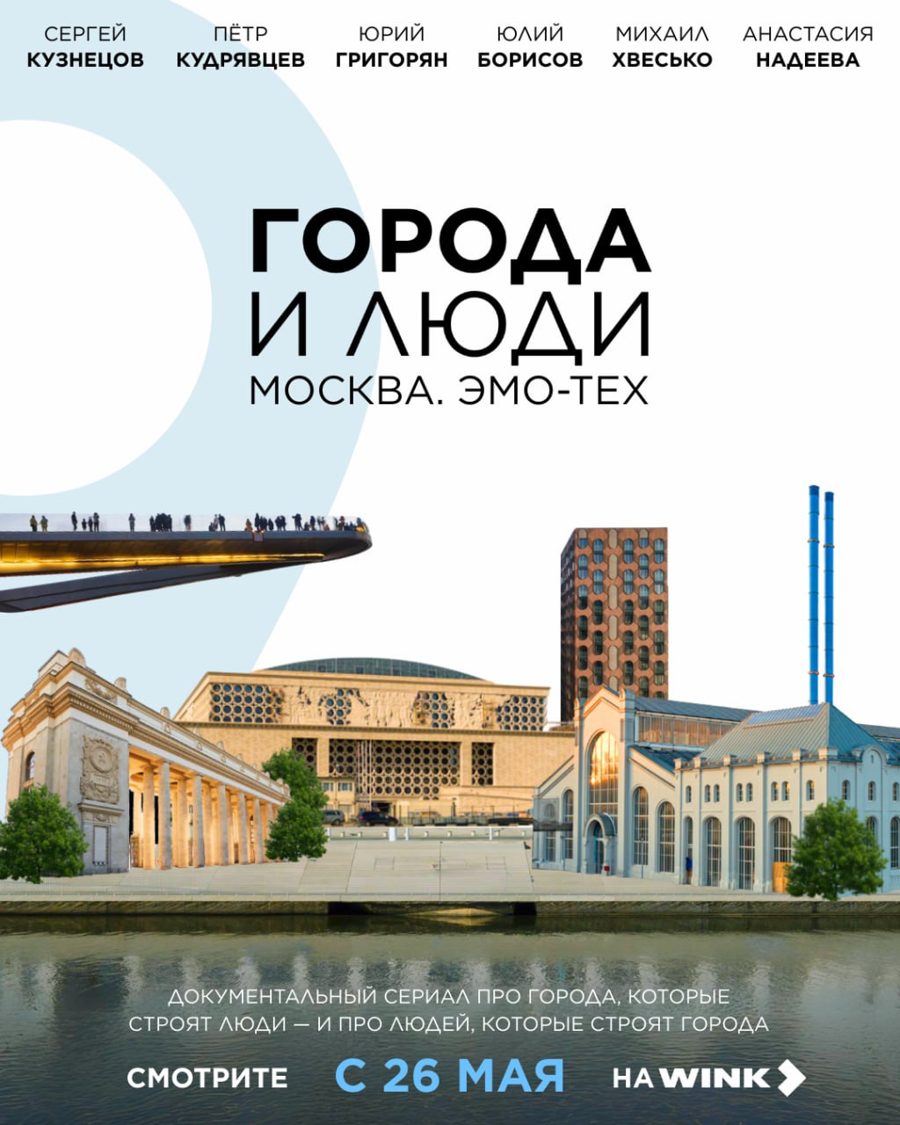
On screen
- Sergey KuznetsovChief Architect of Moscow
- Pyotr Kudryavtsevurbanist
- Yuri Grigoryanarchitect, Meganom
- Yuly Borisovarchitect, UNK
- Mikhail KhveskoCEO, Capital Group
- Anastasia Nadeevaarchitect, APEX
What the episode is about
Emotional techno: Moscow in 2012
A new era begins with Sergey Kuznetsov's appointment as Moscow's Chief Architect. The renovated Gorky Park, Red October and Strelka become the first points of attraction: park, river, factory — the central metaphor of modern Moscow.
Zaryadye: a park on the site of the Rossiya Hotel
The international competition for a park in the heart of the capital was won by a consortium of Diller Scofidio + Renfro, Hargreaves Associates and City Makers. A park without fences, with underground pavilions and year-round life, cost 14 billion roubles.
Industrial zones and the ZILART quarter
After the collapse of the USSR, 35% of Moscow's territory turned into abandoned industrial zones. On 300 hectares of the former ZIL plant the city launched an architectural competition: boulevards, the Chagall Embankment and a park along the railway turned the industrial peninsula into a new urban district.
Luzhniki: rebuilding the aquatics complex
The pool on the Kremlin — Luzhniki — Moscow State University axis was enlarged from 20,000 to 60,000 square metres while keeping the colour, details and feel of the historic building. Architect Yuly Borisov explains how the bureau "got inside the heads" of the original designers.
GES-2: a power station became a house of culture
The 1907 neo-Russian power station was rebuilt to a design by Renzo Piano, with the Russian bureau APEX as general designer. Why GES-2 has four chimneys and why they are blue — explained by Anastasia Nadeeva.
Badaevsky: a city above the city
Capital Group and Herzog & de Meuron raise a residential building above the historic halls of a 19th-century brewery. Slender columns, some of which carry utilities, and a "superslab" — a technological breakthrough that opens a new level of the city above the city in Moscow.
Moscow in 10 years
Sergey Kuznetsov shows renderings of the Moscow of the future — emotional and technological.
Key ideas
Emotional techno. That is, it is technological, it is complex and it is very emotional.
There was a building here that generated energy. Now it is the energy of creativity.
There is a term — the Bilbao effect, when one building put a city on the world map. I think this building can put this part of the city on the world map.
Projects and sites in the episode
| Project | Developer / operator | District | Why it matters |
|---|---|---|---|
| Zaryadye Park | City of Moscow | Kitay-Gorod | A park on the site of the Rossiya Hotel: Diller Scofidio + Renfro, Hargreaves, City Makers; 14 billion ₽ |
| ZILART | LSR Group | Danilovsky | A quarter on 300 ha of the former ZIL plant, the Chagall Embankment |
| Luzhniki Aquatics Complex | Luzhniki | Khamovniki | Pool reconstruction by UNK: floor area grew from 20,000 to 60,000 m² |
| GES-2 | V-A-C Foundation | Yakimanka | A 1907 power station turned house of culture: Renzo Piano and APEX |
| Badaevsky residential complex | Capital Group | Dorogomilovo | A building on columns above 19th-century brewery halls: Herzog & de Meuron |
Questions and answers
Where can I watch the episode "Moscow. Emo-Tech"?
Right on this page: press "Watch" or click the episode poster.
Who appears in the episode?
Sergey Kuznetsov, Pyotr Kudryavtsev, Yuri Grigoryan, Yuly Borisov, Mikhail Khvesko, Anastasia Nadeeva.
Which sites does "Moscow. Emo-Tech" show?
Five landmark Moscow projects: Zaryadye Park, GES-2, Luzhniki, the ZILART district and the Badaevsky residential complex. Through them the film shows how former industrial land becomes neighbourhoods and public spaces.
Press about the episode
- Sostav.ru2 June 2025Cities are built by people: Wink releases a project on how megacities are changing →
- Rambler/News2 June 2025Cities are built by people: Wink releases a project on how megacities are changing →
- AntiglyanetsTelegram"A Moscow you want to live in": for the first time the city has become a place "where you truly want to live" →
- BeskromnyTelegramFirst episode announcement: "Moscow through the eyes of Sergey Kuznetsov, the capital's Chief Architect" →
- Moskovskaya ShchukaTelegram"Now we know who makes Moscow the way we love it": a review of the first episode and the Luzhniki story →
Producer